
Selling a privately held business is one of the most consequential financial decisions an owner can make. The process involved in preparing a business exit is a complex, multidimensional event that simultaneously affects valuation, tax strategy, legal structure, continuity, personal wealth, operational continuity, and interfamily dynamics. Yet many owners enter the process with insufficient advisory, potentially sacrificing significant value, taking on avoidable risks, and increasing the likelihood of not reaching a successful close.
The most successful exits share a common denominator, a coordinated team of specialized advisors, engaged early and working in concert. That team typically includes four key players: an investment bank, a specialized M&A attorney, a wealth management team, and a CPA firm capable of delivering a proactive quality of earnings (QoE) analysis.
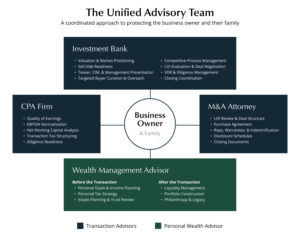
The Investment Bank: Architect of the Process
An experienced investment bank serves as the quarterback of a sell-side transaction. Its role extends well beyond simply finding a buyer. A qualified advisor will conduct a rigorous business valuation, develop compelling positioning and marketing materials, identify and approach the right universe of strategic and financial buyers, and manage a competitive process designed to maximize both price and deal certainty. The team will spend hundreds of hours in preparation on materials and during the launch process speaking with qualified buyers while articulating the growth potential of the business to the right buyer.
A well-crafted sell-side process harnesses meticulous positioning and buyer curation to maximize competitive tension among interested parties, setting the stage for optimal seller outcomes. Buyers, especially private equity firms with sophisticated deal teams, negotiate transactions every day; most business owners do so only once. A seasoned M&A advisor levels the playing field, controls the flow of information, and keeps the seller’s interests central to every negotiation.
The M&A Attorney: Protecting Value in the Details
Not all attorneys are created equal in the context of a business sale. A general practice attorney may handle contracts competently, but M&A transactions require counsel with deep familiarity in deal structure, representations and warranties, indemnification provisions, and post-closing contingencies such as earnouts or escrow arrangements.
A specialized M&A attorney reviews the purchase agreement with precision, identifies provisions that could expose the seller to liability long after closing, and negotiates terms that protect the owner’s financial interests. In complex transactions, legal nuances can be worth millions of dollars.
The Wealth Management Team: Planning for What Comes After the Sale
Sellers often spend months focused on deal value while giving inadequate attention to what happens the moment the wire hits their account. A wealth management advisor with experience in preparing family-owned businesses for liquidity events provides critical pre-transaction planning, including implementing tax mitigation strategies, modeling investment strategies to replace income the business had provided, and ensuring the seller’s estate plan is current and structured appropriately.
Engaging a wealth advisor well before the transaction closes, or even at the same time as engaging an investment bank, creates opportunities to reduce tax exposure and align the proceeds with the owner’s long-term goals. A well-designed financial plan is essential to a successful transition, helping owners replace income previously drawn from the business with income from a customized investment portfolio.
The CPA Firm and Quality of Earnings: Shaping the Financial Narrative
As part of the preparation of financial materials, investment bankers work with an accounting firm, ideally one engaged early in the process to prepare a quality of earnings (QoE) report before the business goes to market. The investment bankers will recommend several CPA firms with specialized transaction advisory teams experienced in preparing sell-side QoE reports.
A QoE provides a detailed financial analysis that normalizes EBITDA, identifies nonrecurring items, provides working capital analysis, and assesses the sustainability of earnings. Nearly all sophisticated buyers, especially private equity, will commission their own QoE during buy-side due diligence. By presenting a credible, seller-prepared QoE, owners can accelerate diligence, demonstrate transparency, reduce the risk of a price retrade, and strengthen their negotiating position.
A proactive QoE also uncovers accounting issues and potential adjustments before buyers do, giving the advisory team time to explain and contextualize them rather than respond under pressure.
In addition to conducting a QoE analysis, a CPA firm can be integral to aiding with financial updates throughout the process, working with the private wealth team on liquidity planning and tax structuring, and reviewing definitive documents through due diligence to close. A qualified CPA firm with a dedicated transaction advisory services function is critical to a seamless sale.
The Cost of Going It Alone
Business owners who engage only one or two of these advisors, or who begin the sale process without coordinating among all four, frequently encounter the same problems: a poorly managed auction that compresses valuation, a legal review that moves too slowly and can jeopardize deals, tax consequences that could have been minimized with earlier planning, or a due diligence process derailed by financial inconsistencies that a QoE would have caught in advance. The advisory fees for assembling this team are typically modest compared to the value a coordinated team creates and increases the probability of a successful, well-executed transaction.
Starting the Conversation
Selling a business is not simply a corporate event, it can be a defining moment in the financial life of the founder and family. The proceeds from a transaction represent years, often decades, of work, risk, and reinvestment. How those proceeds are structured, protected, and deployed can shape the owner’s financial security and legacy for generations. That is why the most prepared sellers engage advisors who think across both dimensions of a transaction: the business impact and the personal impact.
On the business side, an experienced investment banking firm brings coherent strategy to the entire sale process, from valuation and buyer outreach through negotiation and closing. Having a single firm that understands the full arc of the transaction, rather than a disconnected set of service providers, ensures that decisions made at the deal table align with the seller’s broader goals and objectives.
On the personal side, a qualified wealth management team engaged well before closing goes beyond managing the proceeds. It works with the seller and family to:
- Clarify personal goals and objectives before the transaction begins, ensuring the financial outcome is designed around what matters most: retirement security, family support, lifestyle continuity, and long-term financial independence.
- Reduce tax exposure by identifying pre-closing opportunities, such as alternative entity structures, charitable vehicles, and timing strategies that can meaningfully lower the seller’s effective tax rate.
- Address philanthropic goals through structures such as donor-advised funds or charitable remainder trusts, allowing sellers to honor their giving intentions in a tax-efficient manner integrated into the overall transaction plan.
- Review trust and estate needs to ensure that titling, beneficiary designations, revocable and irrevocable trust structures, and generational transfer strategies are in place before liquidity is received rather than scrambled together after the fact.
These considerations are not afterthoughts. They are decisions that, when made proactively, can represent hundreds of thousands or even millions of dollars in preserved wealth and a legacy structured intentionally rather than by default.
At Crewe Capital, we believe the most successful exits are built on the foundation of a coordinated advisory team that treats the transaction and the family’s financial future as a single, unified planning exercise. If you are a business owner considering a sale, whether in the near term or further out, we welcome the opportunity to help you think through the dimensions of what comes next.