When business owners prepare to sell their company or bring on a new equity partner, the conversation naturally gravitates toward multiples, deal structure, and purchase price adjustments. While these are important, one factor that can be underexamined until it creates problems is organizational culture.
Culture is not a soft concept. It is the operating system of a company. It determines how employees make decisions without being told, how they treat customers in unscripted moments, and whether the business can scale without the founder in the room. For buyers, culture is a material part of what they are acquiring. For sellers, it can be one of the most direct determinants of whether a transaction ultimately delivers on its promise.
Culture is a Transaction Variable
A 1999 Fortune magazine article by Ram Charan and Geoffrey Colvin found that CEOs most often failed not because of flawed strategy, but because of their inability to execute it. Their research suggested that firms with merely reasonable strategies, executed with discipline and consistency, could outperform firms with superior strategies that were poorly carried out. Culture is the mechanism through which execution happens.1
For buyers evaluating a business, this distinction matters enormously. A company with strong cultural infrastructure, including clear values, consistent norms, and employees who hold one another accountable, is more transferable. A company that runs on the personality and relationships of the founder, without corresponding cultural infrastructure, represents a concentration risk that buyers can price accordingly.
Researchers Jennifer Chatman and Sandra Cha define organizational culture as a system of shared values, defining what is important, and norms, defining appropriate attitudes and behaviors. Strong cultures enhance performance in two ways: they energize employees by rallying them around meaningful goals, and they coordinate behavior without the inefficiency of formal rules and oversight. That second point is particularly relevant in an M&A context. A business that requires constant supervision to maintain standards is far harder to integrate than one where norms are self-reinforcing.2
What Makes Company Culture Strong
Many companies have cultures where employees generally agree on stated values, but no one cares enough to enforce them or go the extra mile on their behalf. This is common in organizations that treat culture as a branding exercise rather than an operational commitment.2
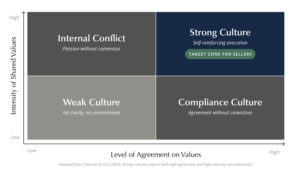
Strong cultures are built on two measurable characteristics: a high level of agreement among employees about what is valued, and a high level of intensity about those values in practice (see Exhibit 1). Both must be present. Agreement without intensity produces compliance. Intensity without agreement produces internal conflict. When both are high, employees hold one another accountable without being asked to, and the organization can deliver at a level that formal policies simply cannot mandate.
Exhibit 1: Culture Strength Framework
For business owners preparing for a transaction, building cultural strength means attending to three things:
- Strategic relevance. Culture must be tied to how the business competes. A company that differentiates on service quality needs cultural norms that support going above and beyond for customers. A company that competes on speed needs norms around urgency and decisiveness. Culture and strategy must be aligned, not operating as parallel tracks.
- Consistency of leadership behavior. Employees pay far more attention to what leaders do than what they say. When leadership behavior is inconsistent with stated values, employees notice quickly and cynicism can follow. Research on what scholars call the hypocrisy attribution dynamic shows that once employees perceive a gap between espoused values and observed actions, commitment erodes and rarely recovers fully.3
- Documented infrastructure. Strong culture does not have to be informal. The most durable cultures are often reinforced through how companies recruit, onboard, and reward employees. Hiring for culture fit in addition to skills, building onboarding that communicates values explicitly, and tying performance reviews to cultural behaviors all create a culture that can survive a change in ownership.
What Buyers are Actually Evaluating
Both financial sponsors and strategic acquirers conduct cultural due diligence, though they can approach it differently and frame the risk in different terms.
Financial sponsors are primarily concerned with whether the business can perform without its founder and whether a new management team can be inserted or supported without disrupting operations. They are evaluating the depth of the cultural bench: do employees understand why decisions are made, or only what decisions were made? Companies where culture is institutionalized, rather than modeled solely by a charismatic leader, typically attract stronger bids and require less post-close intervention.
Strategic acquirers face a different challenge. They are often integrating the acquired business into an existing operation, which means two cultures will have to coexist or merge. Research by Sigal Barsade and Olivia O’Neill highlights that organizations have both a cognitive culture, the shared values and behavioral norms most leaders focus on, and an emotional culture, the shared norms around how employees feel and express themselves at work. Both matter in integration. A strategic acquirer that brings a high-pressure, results-at-all-costs emotional culture into a business built on compassionate care and collaboration can expect disruption, attrition, and performance loss even when the strategic rationale is sound.4
In both cases, what buyers are looking for is a culture that is clear, consistent, and comprehensive. They want a culture that can be understood, preserved, and built upon. Sellers who can articulate their culture in concrete terms, and demonstrate where it shows up in operations, recruiting, and customer outcomes, often present a more compelling and lower-risk acquisition target.
Practical Steps for Business Owners
Culture is not something that can be created a few months before a transaction. It is built over years. Business owners at any stage of their planning can take actionable steps to strengthen their cultural foundation and improve how it is perceived in a transaction process:
- Articulate your values in operational terms. Vague value statements do not hold up in due diligence. Be specific about what your culture looks like in practice. What does a new employee learn in their first 90 days? What behaviors get recognized and rewarded? What behaviors are not tolerated? The more concrete the answers, the more credible the culture.
- Build cultural infrastructure before the process begins. Hiring criteria, onboarding materials, performance review frameworks, and management training are important components. They make culture transferable. A buyer acquiring a company where culture exists only in the founder’s head is acquiring a liability.
- Invest in your management team. Buyers typically acquire businesses with the expectation that the team can carry forward what the founder built. Sellers who have deliberately developed their managers, communicated values, delegated decision-making, and created accountability at multiple levels reduce key-person risk materially and can attract higher valuations as a result.
- Understand your emotional culture. Pay attention not only to what employees do, but to how they feel at work. Research shows that positive emotional cultures, characterized by caring, connection, and shared purpose, produce lower turnover, higher engagement, and better customer outcomes. These are value drivers that belong in the conversation with buyers.4
- Engage buyers in a dialogue about integration. For sellers who plan to retain equity and remain involved post-close, the buyer’s approach to cultural integration is a material consideration. Ask directly: how have they navigated culture in prior acquisitions? What happened to leadership teams? What does the first 90 days typically look like? The answers reveal whether the partnership is likely to preserve or erode what you have built.
Conclusion
Culture is too often discussed after the economics are settled. In reality, it should be considered alongside them. A business with strong, documented, and transferable culture commands more confidence from buyers, supports a smoother transition, and is more likely to deliver on the value creation story that justifies the transaction.
At Crewe Capital, we help business owners think through every dimension of what makes their company valuable, including the organizational infrastructure that buyers increasingly recognize as a core driver of post-close performance. If you are considering a sale or partnership, we would welcome the conversation.
References
- Charan, R. and Colvin, G. “Why CEOs Fail.” Fortune, June 21, 1999.
- Chatman, J.A. and Cha, S.E. “Leading by Leveraging Culture.” California Management Review, Vol. 45, No. 4, Summer 2003.
- Cha, S.E. and Edmondson, A. “How Strong Organizational Values Can Inhibit Learning.” Working paper, Harvard University, 2001.
- Barsade, S. and O’Neill, O.A. “Manage Your Emotional Culture.” Harvard Business Review, January–February 2016.